
 |
Many patients who have turned to hair transplant clinics both in Italy and abroad then came to Hasci Italia because they have a completely used donor area while their recipient area is not fully restored. They are therefore left with a half-bald head and unable to complete hair restoration due to lack of available follicular units. Now let’s see how this is possible, why it happens, and how the patient should behave when consulting institutes offering the FUE technique, whatever its commercial name. |
Consultation for FUE technique
In an FUE consultation, the patient is offered a transfer of follicular units from the donor area to the recipient area. Most of the time, the number of follicular units proposed for transplantation is very high, in the order of several thousand, depending on the quality of the donor area and the surface of the recipient area to be restored. What is never explained to the patient concerns the donor area. In fact, all the discussion focuses on the recipient area, which is what interests the patient.
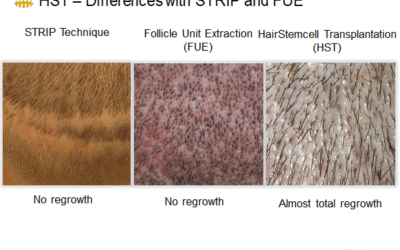
The donor area with FUE technique does not regrow or regenerate
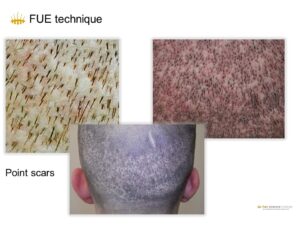
Everything about the donor area is hidden, which unfortunately, after extractions, becomes dotted with small scarred gaps. Besides, all these thousands of scars often cause fibrotic hardening of the scalp; the patient is unaware that the density of their donor area will dramatically decrease. And the worst happens when, to cover fairly large recipient areas, the amount of extractions becomes significant, sometimes taken over two consecutive days.
This means the donor area can be reduced to a minimum, without the patient being informed. This precludes any possibility of a further intervention. Many institutes know that the patient will not return for a second procedure, especially if they had the transplant abroad (but this sometimes happens in Italy as well), so they extract the maximum possible without caring about the state in which they leave the donor area.
How to restore FUE-damaged cases with Hasci Italia HST technique
At Hasci Italia we receive many patients truly disappointed with the result of their FUE transplant. They still have an unsatisfactory result in the recipient area, and if they eventually return to the same institute for a second transplant, they are told that their donor area can no longer tolerate any extraction. Sometimes the donor area is so exploited that it is clearly visible in the occipital region.
In light of these disastrous outcomes, we advise patients who have not yet decided on a particular technique to focus during consultation also on the donor area and explicitly ask what the institute proposes regarding it. Unfortunately, this question will remain unanswered because all FUE transplants leave gaps in the donor area and there is no solution to prevent it.
How the HST Hair Stemcell Transplantation technique works
With HST Hair Stemcell Transplantation, surgeons at the Hair Science Clinics, the only ones authorized to operate with this technique, transplant only portions of follicular units taken from the donor area. In this way, the hair stem cells contained in a follicular unit are divided into two portions: one remains in the donor area and the other is transplanted into the recipient area.
This entire process is done by extracting portions of follicular units with extremely small-diameter needles, 0.6 millimeters, smaller than the smallest needles used in FUE and in any case smaller than the follicular units. With this HST technique, the two portions of a follicular unit each give rise to a new follicular unit, one in the donor area and one in the recipient area. From the original follicular unit, two identical units are created. The consequences of this small miracle are multiple: the number of follicular units available for transplantation is multiplied, which is why this method is also called Hair Multiplication.
Donor area regenerated in nine months with Hasci Italia HST technique
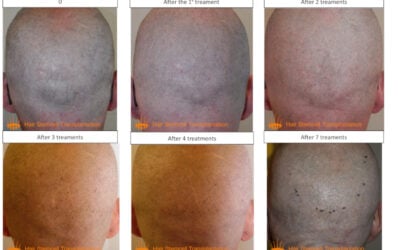
Specifically, the donor area, within nine months corresponding to the human hair growth cycle, regenerates and regains its pre-operative appearance.
This is a significant advancement in hair transplant practice, as all the negatives caused by creating gaps in the donor area are overcome by the fact that the donor area is restored.
Very natural results thanks to closely spaced implants with Hasci Italia HST
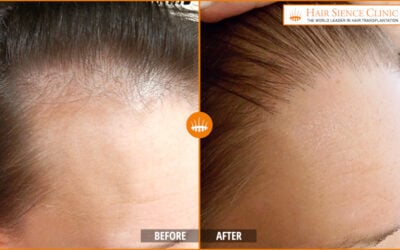
Moreover, in the recipient area, the grafts are implanted with extremely high density, considering that they are placed using even smaller needles, 0.5 millimeters in diameter, allowing very close placement between grafts and thus a very natural appearance.
Hasci Italia also often receives requests to regenerate overly exploited and unaesthetic donor areas. Using the same system, the HST technique allows progressive re-densification in these cases.
With HST the donor area regenerates and hair density can be restored
Discover how Hasci Italia HST technique can correct the damage caused by FUE transplants and provide natural results 👉 Book a personalized consultation