
Setting out to restore a full, natural head of hair can feel overwhelming. For people looking for an advanced solution, the HST method, based on research into hair follicle stem cells, offers an innovative alternative to traditional transplants. This technique is designed to deliver real, long-lasting results while avoiding many of the drawbacks of older procedures. Here is what makes this approach unique and how it is changing the outlook for people facing hair loss.
What makes the HST method different from conventional transplants?
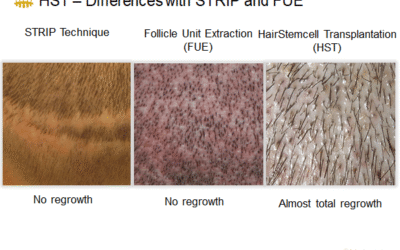
Hair transplantation has evolved considerably in recent years. Techniques such as FUE (Follicular Unit Extraction) and FUT (Follicular Unit Transplantation) are widely used, but the HST hair stem cell transplant takes a different approach. Hair Stem Cell Transplantation (HST), known in the scientific literature as PL-FUT, makes use of the stem cells contained in each follicular unit to allow hair to grow in both the donor and recipient areas.
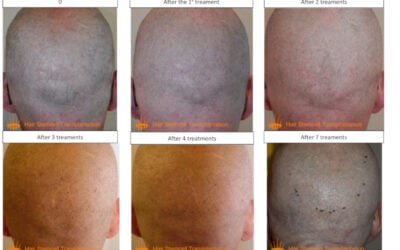
Conventional procedures move entire follicular units from the donor area to balding areas, and the donor area cannot grow those hairs back. The major advantage of the HST method is that hair grows in both the donor and recipient areas, which limits thinning where grafts are taken and preserves overall density.
How does hair stem cell transplantation work?
HST relies on the precise partial extraction of follicular units, using very fine needles of just 0.6 mm in diameter. Instead of removing a whole follicular unit, only a portion containing stem cells is taken and transplanted, while the rest stays in place. Hair can then grow in two places: the donor area regenerates over the natural hair growth cycle of around nine months, and the recipient area gradually grows new hair.
This minimally invasive, high-precision technique causes very little trauma and minimal scarring. Recovery is generally comfortable, and your medical team will tell you when you can return to your usual activities. Once healed, signs of the procedure are generally very discreet.
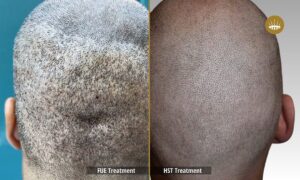
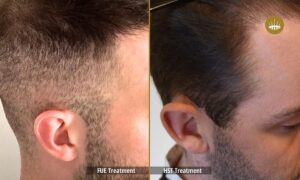
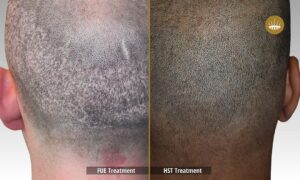
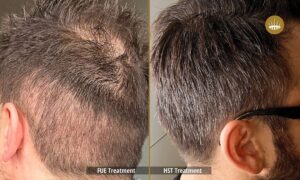
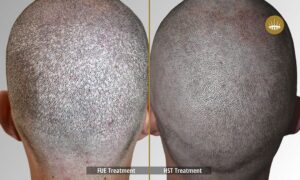
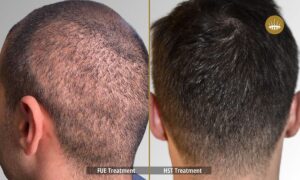
FUE compared with HST. Individual results vary.
Precision for natural-looking results
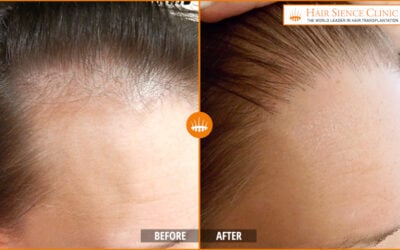
The HST method is based on research into how hair follicles regenerate. By extracting only part of each follicular unit, the surgeon allows hair to grow at both the extraction and implantation sites. Implantation with even finer 0.5 mm needles allows grafts to be placed very close together, avoiding the “plugged” look of older techniques and creating soft, natural-looking hairlines.
The technique is also used to restore eyebrows or cover burn scars, so it is not limited to receding hairlines. This versatility means it can meet very different needs, from general thinning to specific cosmetic goals.
Long-lasting results
One of the most appealing aspects of hair stem cell transplantation is that the results last. Unlike topical products or temporary solutions, transplanted hair behaves like your own hair: it grows, ages and goes through normal growth cycles, and can be styled, colored or cut as you wish.
Transplanted hair generally keeps growing over the long term. However, a transplant does not stop natural hair loss in the areas that were not treated, so your doctor may discuss with you how your hair loss is likely to evolve and whether further sessions could be useful in the future. Because the donor area is preserved, these remain possible.
Who can benefit most from HST?
The HST method is suitable for a wide range of patients. People with male or female pattern hair loss, localized thinning, or hair loss following a medical condition or an accident may find it particularly suitable. If you would like to learn more, you can book a personalized consultation.
Patients with advanced hair loss are not necessarily excluded, as the technique makes the most of the available donor area. Many people who felt limited by other treatments therefore find new options with HST.
- Patients with genetic hair loss (male or female pattern)
- People with traction alopecia or a damaged hairline
- Patients needing eyebrow or facial hair restoration
- People with burns or surgical scars affecting the scalp
What to consider before choosing HST
Although the HST method offers promising results, several factors should be considered before going ahead. The technique requires specific expertise, so it is only available in a small number of clinics, and its cost reflects the precision of the procedure. A consultation with an experienced specialist helps confirm whether it is suitable for you and set clear expectations.
Even though scarring is minimal and recovery comfortable, individual responses vary. A thorough, personalized assessment, taking into account your hair type, hair color and skin characteristics, makes it possible to match your goals with a realistic result. For any further information, feel free to contact our team.
Is HST backed by science?
The PL-FUT technique on which HST is based has been described in peer-reviewed scientific publications, which report regrowth of the donor area after partial extraction of follicular units. This is what allows HST to combine a natural-looking result with preservation of the donor area.
As research in regenerative medicine and hair biology continues, techniques like HST are likely to keep evolving. During your consultation, the doctor will explain what results you can realistically expect in your case.
Frequently asked questions about hair regrowth with HST
Does the HST method leave visible scars?
The HST technique is designed to minimize scarring. Only small portions of follicular units are removed with very fine needles, so the donor area usually heals very discreetly. Once healing is complete, short hairstyles are often possible.
Can hair grow back in both the donor and recipient areas?
Yes, because the procedure transplants portions of follicular units containing stem cells rather than whole units. Hair grows in both areas:
- The donor area keeps part of each follicular unit, which allows it to regenerate.
- The recipient area grows new hair from the implanted grafts.
This is what sets HST apart from conventional transplant techniques.
Who is suitable for hair stem cell transplantation?
Suitability depends on several factors, including the extent of hair loss, the condition of the scalp and your goals. Many people with different forms of hair loss, burn scars or thinning eyebrows are suitable, but a personalized assessment is always needed.
| Situation | Suitability for HST |
|---|---|
| Pattern hair loss | Generally suitable |
| Localized scarring | Generally suitable |
| Very advanced baldness | Variable, requires a consultation |
How long do HST results last?
Transplanted hair generally keeps growing over the long term, following its natural growth cycle, and needs only normal care. Natural hair loss may continue in untreated areas, so a further session may sometimes be considered later. Because the donor area is preserved with HST, this remains possible.