
Hair loss can deeply affect self-confidence and the way people see themselves, which is why effective, long-lasting solutions are so sought after. In recent years, advances in regenerative medicine have led to innovative techniques such as hair stem cell transplantation (HST/PL-FUT). This method has changed the field by making it possible not only to increase hair density where it is needed, but also to allow the donor area to regenerate. But what exactly lies behind this science-based approach, and why does it stand apart from earlier methods?
The fundamentals of hair stem cell transplantation
At its core, HST, also called partial longitudinal follicular unit transplantation (PL-FUT), relies on the body’s natural ability to regenerate. Instead of extracting entire follicles, the surgeon carefully removes only a portion of each selected follicular unit. These fragments contain stem cells, which play a key role in hair regrowth. As a result, hair can grow both in the newly implanted area and in the donor area, where the remaining part of each follicle stays in place.
The procedure uses very fine instruments: needles of just 0.6 mm in diameter for extraction, smaller than the follicular units themselves. Thanks to this precision, trauma to the scalp is limited and the impact on the donor area is much lower than with conventional approaches, which makes recovery more comfortable for patients.
Main differences from traditional hair transplant techniques
In the field of hair restoration, classic procedures such as follicular unit extraction (FUE) and follicular unit transplantation (FUT) have long been the standard. Stem cell-based transplantation takes a different approach, which has been described in several scientific studies on PubMed.
How do FUE/FUT and HST compare?
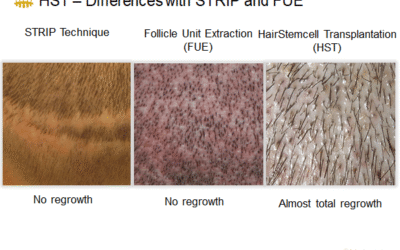
Traditional methods remove either individual follicular units (FUE) or a strip of scalp containing many follicles (FUT), taking them permanently from the donor area. While these methods can provide coverage, they inevitably reduce the overall supply of donor hair and often leave visible scars. Above all, the removed follicles do not grow back in the donor area.
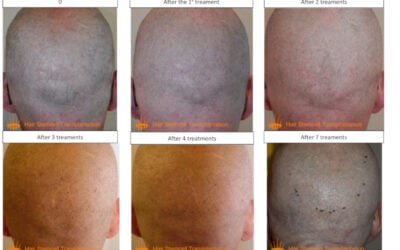
Stem cell hair transplantation stands out by extracting only part of each follicular unit. Stem cell-rich tissue remains in the donor area, allowing it to regrow, while the extracted portion grows in the recipient area. Hair therefore remains available for future sessions, without exhausting the donor area. If you would like to explore your options, you can book a personalized consultation to find out whether this technique is suitable for you.
Long-term planning and natural-looking results
A major limitation of older techniques is the limited donor supply, which can restrict future options. With HST/PL-FUT, the regeneration of the donor area keeps more options open for additional procedures if needed. In addition, implantation with even finer needles, 0.5 mm in diameter, allows grafts to be placed very close together, so that hairlines look soft and natural, whatever the hairstyle or length.
Regeneration and benefits for patients
The most distinctive advantage of HST is its regenerative potential. Because active stem cells are preserved in the part of each follicle left in place, the donor area regenerates over the natural hair growth cycle of around nine months, while still providing grafts for the recipient area. The PL-FUT technique has been described in peer-reviewed publications.
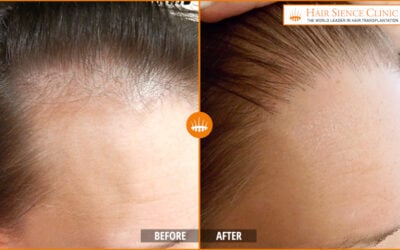
As a minimally invasive procedure, HST does not leave a linear scar, so many patients can wear short hairstyles discreetly. Comfortable recovery and very discreet signs of the procedure are among the main reasons why many people choose stem cell hair transplantation today.
Key features of stem cell hair transplantation
If you are considering a modern hair restoration treatment, understanding its specific advantages helps set clear expectations. Here are the key points:
- Preserved donor supply thanks to partial extraction of follicular tissue
- Reduced risk of scarring after the procedure
- Greater flexibility for several sessions over time
- High-density placement and natural angle of the transplanted hair
- Comfortable recovery and natural blending with existing hair
This technique is particularly well suited to delicate areas such as the eyebrows or temples, or whenever a very precise design is needed. By reproducing the natural direction and movement of hair, the surgeon can tailor the treatment to each patient’s needs and desired look.
At a glance: comparison table
To clearly show the differences between the main hair restoration techniques, here is a simple comparison:
| Attribute | FUE / FUT | HST / PL-FUT |
|---|---|---|
| Donor area regrowth | No | Yes, thanks to the preserved stem cells |
| Visible scarring | Micro-scars or linear scar | Minimal, very discreet |
| Possibility of future sessions | Limited by donor depletion | Preserved |
| Natural appearance | Good, sometimes detectable | Very natural and discreet |
Patients looking for discreet, long-lasting results often choose HST for these practical and aesthetic advantages. For more information or specific questions, don’t hesitate to contact our team.
Frequently asked questions about hair stem cell transplantation
What makes hair stem cell transplantation different from older methods?
Hair stem cell transplantation removes only part of each follicular unit, leaving stem cells in place in the donor area. Unlike FUE or FUT, this allows hair to regrow in both the donor and recipient areas, preserving the donor supply and keeping changes on the scalp very discreet.
- No linear scar after healing
- Future procedures remain possible
| Method | Donor area regrowth |
|---|---|
| FUE/FUT | No |
| HST/PL-FUT | Yes |
Is the procedure suitable for people who want a completely natural hairline?
Yes. HST/PL-FUT allows the surgeon to create a soft, natural hairline through careful placement and attention to the direction of growth. The transition with surrounding hair is designed to be smooth, including with short hairstyles.
- Dense implantation for good coverage
- No harsh edges or artificial angles
Does stem cell transplantation reduce visible scarring compared to earlier procedures?
Yes. Because the procedure is minimally invasive and only microscopic portions are extracted, it avoids the large or linear scars typical of earlier techniques. Once healed, any traces are generally very discreet.
- Extraction with very fine 0.6 mm needles
- Regeneration of the donor area
Are further procedures possible with HST/PL-FUT if needed?
Because HST/PL-FUT allows the donor area to regenerate, further sessions remain possible if needed. With standard methods, by contrast, repeated procedures can exhaust the available hair and limit future options.
| Technique | Possibility of further sessions |
|---|---|
| FUE/FUT | Generally limited |
| HST/PL-FUT | Largely preserved |