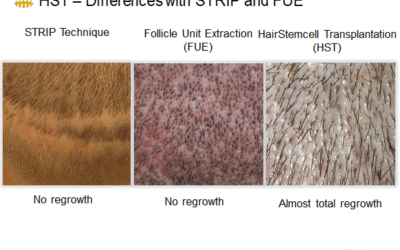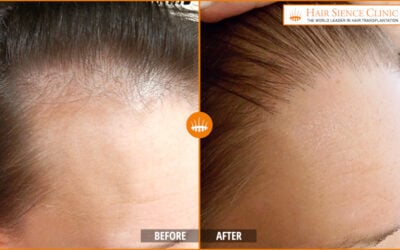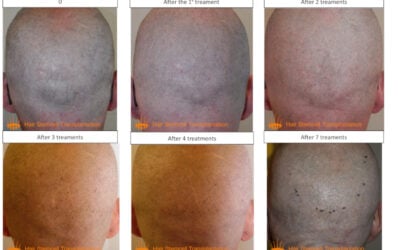

Today, patients suffering from alopecia often have two options for intervention: either FUT, also called strip, or FUE. The first involves the removal, which can be quite painful, especially in the post-operative phase, of a strip of scalp from the occipital donor area.
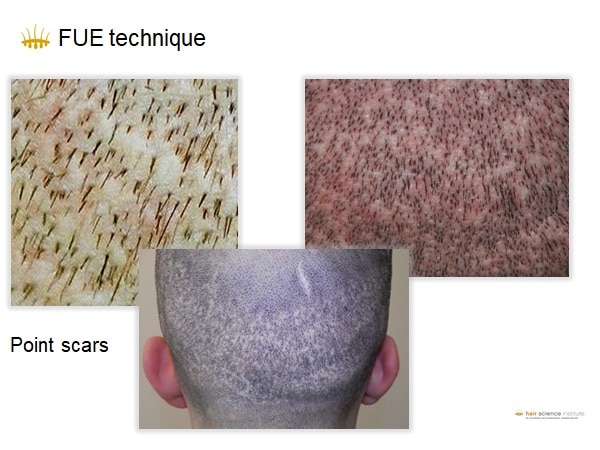
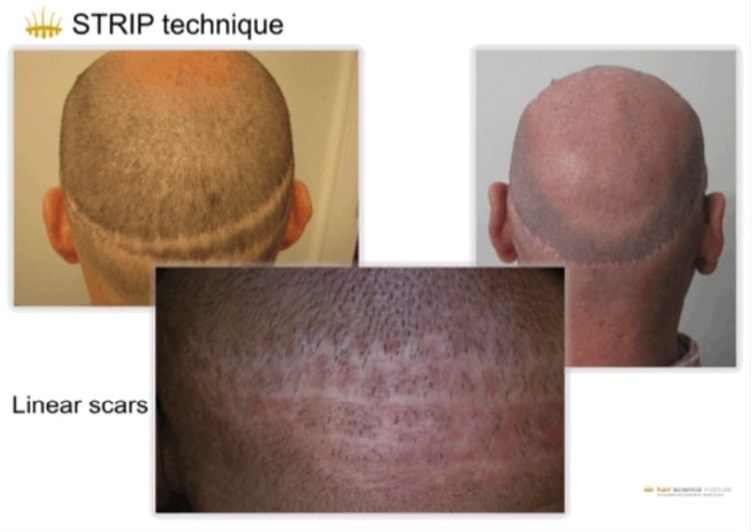
This strip is carefully dissected, and each follicular unit obtained separately is transplanted into the recipient area. Suturing the two edges of the wound created by the removal produces a long and truly unsightly scar. With the second technique, FUE, the surgeon extracts each follicular unit individually and entirely, then transplants it into the recipient area. In place of the extracted unit, a hole is created which will heal, potentially causing hardening across the donor area.
 |
 |
 |
FUT and FUE: Both Techniques Only Move Follicular Units
The common feature of both techniques, beyond the method of extraction, is that they only transport the available follicular units from the donor area to the recipient area. Their limitation lies in the number of follicular units potentially available for harvesting and the size of the area to be restored.
In cases of extensive alopecia, the follicular units are never sufficient, therefore: the donor area is completely devastated by very large extractions, and the restoration will still be incomplete without hope of completing the work due to the exhaustion of the donor area. Unfortunately, the dreams of many patients are broken because so many promises cannot be fulfilled. The most painful aspect is that after exhausting, unfortunately without satisfactory results, the entire capacity of the donor area, the patient must accept that a proper restoration is no longer possible.
Dr. Gho’s Scientific Research
Aware of these difficulties, Dutch physician-researcher Coen Gho undertook extensive in vitro and in vivo studies based on his intuition. These studies were later published in the prestigious English-language scientific journal, the Journal of Dermatological Treatment.
He knew that there were different groups of stem cells located within follicular units. He had the idea to verify through experiments conducted both in vivo and in vitro whether follicular units could survive partial extraction and if they could regenerate new follicular units. About 100–150 grafts taken from the occipital donor area were transplanted into five patients.
Exclusive HST Transplant Technique with Very High Success Rate
The evolution of these grafts was observed over a long period. After three months, between 92.1% and 104.1% (average 97.7%) of the partial harvests in the donor area had survived and regenerated hair of the same quality as the original. After one year, between 91.1% and 101.7% (average 95.9%) of the partial follicular unit implants had generated hair with the same characteristics as those taken from the donor area.
It was then shown that harvesting portions of follicular units instead of entire units was exactly equivalent, with the considerable advantage of having a regenerated donor area. In this way, it was possible to demonstrate that from one follicular unit, two identical units could be created, fully preserving the donor area. From this experience, the complete procedure currently practiced was developed.
Dr. Gho patented a formula for a pharmacological compound containing exosomes and portions of extracellular matrix that give strength and vitality to the tiny grafts that are almost tissue-free. The grafts are kept in this solution for at least two hours. With this experience, corroborated by studies conducted by eminent scientists such as Professor Kim, Professor Choi, Professor Reynolds, and others, it is understood that the proximal and distal parts of a follicular unit contain hair stem cells responsible for hair growth.
Exclusive HST Transplant Technique: Regenerated Donor Area and Follicular Unit Multiplication
In the case of a partial longitudinal harvest of follicular units, when hair stem cells remain in both the extracted portion and the portion left in the donor area, it is possible to assert that a donor area can be used multiple times for successive grafts.
This concept represents today the most notable advancement in the field of hair transplantation. Many patients with donor areas already poor or damaged by excessive extractions from other techniques can see the possibility of regaining their desired hair again.
Exclusive HST Transplant Technique: No Scars, No Bandages, Light Post-Operative Period
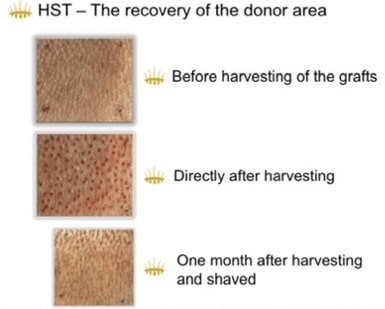
HST offers significant secondary advantages: no need for bandages after the procedure due to the tiny incisions. The post-operative period is simple, gentle, and extremely easy.
No scars, no hardening of the scalp, the tiny half-millimeter implants allow for extremely dense reconstruction in the recipient area, providing an extremely natural result and high density.