
Solutions for hair loss keep evolving, but few generate as much interest as the HST technique, known in the scientific literature as PL-FUT. Based on the principle of hair multiplication and regeneration of the donor area, it goes further than simply moving hair from one place to another. With so many marketing claims around hair restoration, verifiable scientific evidence from recognized medical databases is the best way to tell techniques apart. For anyone looking for real proof rather than promises, understanding the scientific foundation of HST PL-FUT is essential. Below, we look at the peer-reviewed research behind this approach and what it means for patients.
The principles behind HST PL-FUT
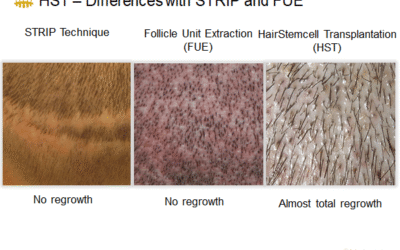
Unlike traditional methods, which remove entire follicular units and can visibly thin the donor area, HST PL-FUT uses partial extraction. Only a portion of each follicular unit is taken, with very fine needles of just 0.6 mm in diameter, while the rest stays in place. As a result, hair can grow in both the donor and recipient areas, thanks to the stem cells preserved in each part.
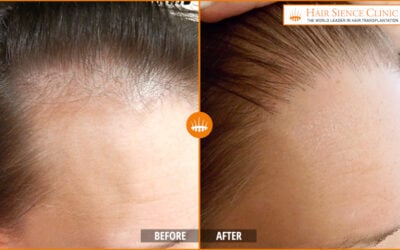
This approach aims not only at aesthetic restoration but also at the long-term health of the scalp. Instead of simply redistributing existing follicles, the goal is to allow the donor area to regenerate, which is not possible with conventional hair transplant techniques.
PL-FUT compared with FUE and FUT: what is the difference?
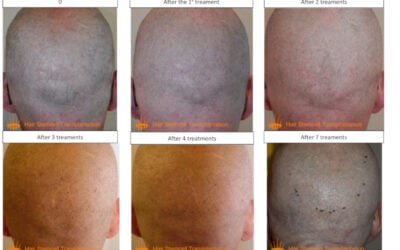
FUE (Follicular Unit Extraction) and classic FUT (Follicular Unit Transplantation) remove whole follicular units or strips of scalp. PL-FUT (Partial Longitudinal Follicular Unit Transplantation) leaves part of each follicular unit behind. Thanks to this difference, the transplanted portion grows new hair in its new location, while the part left in the donor area can regenerate over the natural hair growth cycle of around nine months. This preserves the donor supply and keeps further sessions possible.
For patients with a limited donor area, this changes how treatment can be planned. It opens up options for people who were previously discouraged by the limits of their donor area with standard approaches.
The biological basis of regeneration in PL-FUT
The key to the PL-FUT method lies in the role of follicular stem cells. Because each follicular unit is only partially divided, both the extracted portion and the part left in the donor area retain enough regenerative potential to produce hair again. This is the mechanism described in the publications of Dr Coen Gho and Prof. Martino Neumann.
This principle places the procedure within the field of regenerative medicine, alongside other approaches that aim to restore function rather than simply hide a problem. The published work describes donor area regrowth based on clinical follow-up and photographic documentation.
What PubMed-indexed publications say
Independent peer review gives credibility to any medical technique. Several scientific studies on PubMed describe the PL-FUT technique and its applications. They were written by Dr Coen Gho, who developed the technique, and Prof. Martino Neumann, of Erasmus University Medical Center in Rotterdam, and were brought together in Dr Gho’s doctoral thesis in 2019.
These publications cover both the principle of the technique and its practical applications:
- The preservation of the donor area through partial extraction of follicular units
- The principle and development of PL-FUT
- Its use in specific cases, such as burn scars and eyebrow restoration
| Publication | Main focus | Reference |
|---|---|---|
| Donor hair follicle preservation by partial follicular unit extraction. A method to optimize hair transplantation Gho CG, Neumann HAM |
Preservation of the donor area after partial extraction | Journal of Dermatological Treatment, 2010; 21(6): 337–349 – PMID: 20388024 |
| Improved hair restoration method for burns Gho CG, Neumann HAM |
Hair restoration on burn scars | Burns, 2011; 37(3): 427–433 – DOI: 10.1016/j.burns.2010.09.011 |
| Restoration of the eyebrows by hair transplantation Gho CG, Neumann HAM |
Application of the technique to eyebrows | Facial Plastic Surgery, 2014; 30(2): 214–218 – DOI: 10.1055/s-0033-1363761 |
| Advances in hair transplantation: longitudinal partial follicular unit transplantation Gho CG, Neumann HAM |
Principle and development of PL-FUT | 2015 – PMID: 26370653 |
What PL-FUT changes for patients
Traditional hair transplants consist of moving hair and are limited by the amount available in the donor area. PL-FUT adds a regenerative dimension that changes long-term planning: because hair grows back in the donor area, patients with a limited donor reserve can consider several sessions over time.
This widens the range of patients who may be suitable and keeps options open for the future. If you are considering your options, you can book a personalized consultation to discuss whether PL-FUT is right for you. Implantation with even finer 0.5 mm needles and careful handling of the grafts also contribute to natural-looking results.
Why scientific transparency matters
Publishing methods and results in peer-reviewed journals allows other doctors to examine and discuss a technique, which helps patients and practitioners make informed decisions. When choosing a hair restoration technique, asking whether it has been described in recognized scientific publications is a good way to separate evidence from promotional claims.
As interest in hair restoration grows, so does research. If you have questions or would like to learn more, feel free to contact our team. The meeting of stem cell biology and hair surgery will continue to shape restorative treatments in the years to come.
Frequently asked questions about HST PL-FUT and the science behind it
How does PL-FUT differ from traditional FUE and FUT?
PL-FUT (Partial Longitudinal Follicular Unit Transplantation) removes only part of each follicular unit rather than the whole unit. This allows the donor area to regenerate, while the transplanted portions grow in the recipient area. Traditional FUE and FUT remove whole units or strips, which can lead to permanent thinning of the donor area.
- PL-FUT preserves stem cells in both areas.
- Several sessions remain possible without exhausting the donor area.
What scientific publications describe PL-FUT?
Several peer-reviewed articles by Dr Coen Gho and Prof. Martino Neumann describe the technique and its applications. They cover donor area regrowth after partial extraction, the principle of PL-FUT and its use in specific cases.
| Year | Topic |
|---|---|
| 2010 | Preservation of the donor area by partial extraction |
| 2011 | Hair restoration on burn scars |
| 2014 | Eyebrow restoration |
| 2015 | Advances in longitudinal partial follicular unit transplantation |
Is HST PL-FUT suitable for everyone?
Not everyone is an ideal candidate for PL-FUT. Scalp health, the extent of hair loss and your personal goals all determine suitability, which is why a thorough assessment by a specialist in regenerative hair restoration is essential. The technique is particularly advantageous for patients with a limited donor reserve.
- Patients who want minimal visible scarring often prefer this option.
- Patients who may need several sessions benefit from greater flexibility.
Why does publication in international databases matter for hair restoration techniques?
Peer-reviewed publications allow other doctors to examine and verify a technique. Being indexed in recognized medical databases such as PubMed means the work has been reviewed by experts before publication, which builds trust for both clinics and patients.
- Makes it possible to compare techniques on a factual basis.
- Helps patients decide based on evidence rather than promotional claims.