
Hair transplants have greatly expanded the options available to people looking for a lasting solution to hair loss. However, not every procedure delivers the dense, permanent result patients hope for, especially with techniques such as FUE (Follicular Unit Extraction). Insufficient density, visible scarring or an overharvested donor area can leave patients disappointed. HST (Hair Stem Cell Transplantation), known in the scientific literature as PL-FUT, offers real possibilities for anyone considering a repair procedure after a first FUE.
Why consider repair after an FUE hair transplant?
Being disappointed after an FUE hair transplant is not unusual. Although the technique has become popular because it is minimally invasive, it does not always deliver a satisfying result. So what leads patients to consider another procedure after FUE?
The main reasons are insufficient density, a harsh or unnatural hairline, or visible scars left by the first transplant. In particular, aggressive harvesting can damage the appearance and health of the donor area, limiting future treatment options and leaving lasting cosmetic concerns.
Common problems after FUE
Understanding the technical and aesthetic limitations that can follow FUE helps explain why some patients turn to repair with a more advanced technique. For those interested in the scientific background, several scientific studies on PubMed describe the PL-FUT technique used for these repairs. The typical issues are both cosmetic and physiological.
A depleted donor area: what are the risks?
During FUE, entire follicular units are extracted from the donor area, sometimes several thousand in a single procedure. This depletion is not always visible right away, but it can lead to patchiness or reduced density over time, because the removed follicles do not grow back. As a result, patients are sometimes told later that there is not enough donor hair left for a conventional corrective transplant.
Visible scars and an unnatural hairline
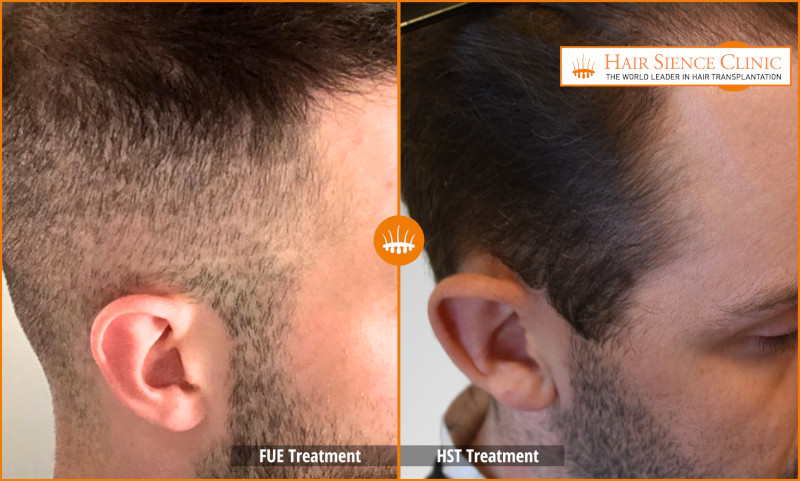
Although FUE is presented as leaving minimal scarring, the many extractions often leave small gaps or white dots that become visible with short hairstyles. In addition, the angle and density of the transplanted hair can look less natural than hoped, giving a sharp, “transplanted” look rather than a seamless blend with existing hair.
How does HST/PL-FUT make repair possible?
Hair restoration has evolved considerably. HST/PL-FUT stands out for its ability to address problems caused by earlier transplants. So what makes it different from conventional approaches?
The regenerative principle of HST
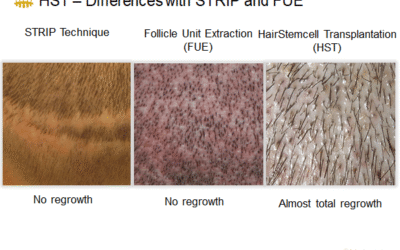
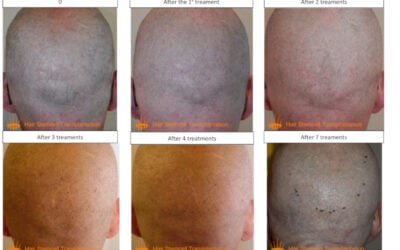
Unlike FUE or FUT, HST extracts only a portion of each follicular unit instead of the whole unit. Each follicular unit is in effect divided: part of its stem cells stays in the donor area, while the other part is implanted in the recipient area. Both parts can then give rise to a new follicular unit, so hair grows again where it was taken and where it is implanted.
High density, minimal scarring
Extraction is carried out with very fine 0.6 mm needles, smaller than the follicular units themselves, and implantation with even finer 0.5 mm needles. This precision allows grafts to be placed very close together, for a result that follows natural hair patterns and keeps the hairline soft, which is difficult to achieve with larger instruments. Because part of each follicle remains in the donor area, the extraction sites heal very discreetly and the donor area regenerates over the natural growth cycle of around nine months. If you are considering your options, you can book a personalized consultation to discuss your situation.
The benefits of HST/PL-FUT for correction
Choosing HST/PL-FUT for a repair procedure offers clear advantages for patients dissatisfied after FUE, and avoids many of the drawbacks of earlier techniques.
- Regeneration of both the donor and recipient areas
- Coverage of previous surgical scars with new hair
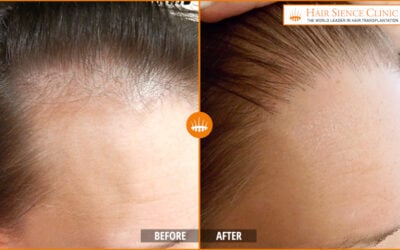
- Increased density in thinning areas
- Natural direction and texture in the restored hairline
- Aesthetic improvement, even in complex cases
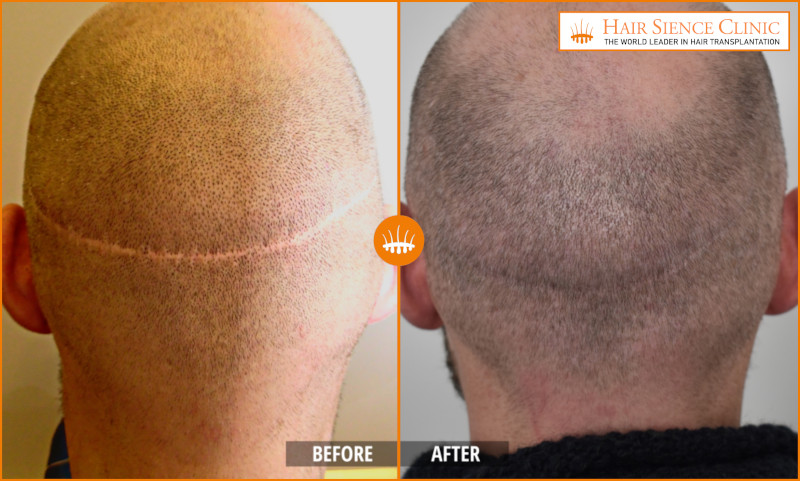
As a result, many patients regain hope of achieving the look they want, even when their donor area was considered unusable or heavily scarred.
Planning a corrective hair transplant: what to consider
Before a second hair transplant, several personalized assessments guide the decision. The remaining donor supply, the extent and location of scars, the overall health of the scalp and your personal goals all shape the recommended strategy.
The consultation should aim to preserve as much healthy tissue as possible and clearly explain what can realistically be achieved in your case. If you have any questions, don’t hesitate to contact our team. Clinics experienced in HST/PL-FUT work with microscopic precision to deliver discreet, natural-looking improvements where other approaches may fall short.
| Method | Main advantage | Main drawback |
|---|---|---|
| FUE | No linear scar | Permanent donor depletion, dotted scars |
| Traditional FUT | Large number of grafts in one session | Visible linear scar |
| HST/PL-FUT | Donor regeneration, high density, minimal scarring | Complex technique that requires specific expertise |
Frequently asked questions about repair after FUE with HST/PL-FUT
Can HST/PL-FUT help if the donor area is severely depleted after FUE?
In many cases, yes. One of the key advantages of HST is that it makes the most of a limited donor area. Because part of each follicular unit stays in place, hair grows back in the donor area, which makes it a possible option even when previous procedures have left little hair available. Suitability is confirmed during a medical assessment.
- Part of each follicular unit remains in the donor area
- Hair grows in both the donor and recipient areas
- The surgical plan is adapted to the available donor hair
How long does it take to see results after a corrective HST procedure?
First regrowth usually appears after 3 to 4 months. The donor area regenerates over around nine months, and the final result in the recipient area generally develops over 9 to 12 months, with density and coverage gradually increasing.
| Timeframe | What to expect |
|---|---|
| 3–4 months | First signs of regrowth |
| 6 months | Hair becoming thicker |
| 9–12 months | Final, natural-looking result |
How are old scars covered with HST/PL-FUT?
The surgeon implants grafts directly into and around old scars, so that new hair grows over them and reduces the contrast with the surrounding scalp. Careful planning ensures that this hair blends with the existing hair for a discreet result.
- Precise graft placement under the microscope
- Gradual thickening as the hair grows
- A natural blend with surrounding hair
Is repair after FUE possible for everyone?
Many patients can benefit from repair with HST/PL-FUT, but suitability depends on several factors, such as scalp health, the remaining donor reserve and previous procedures. A specialist will assess your situation to ensure safety and realistic expectations.
- An individual assessment is essential
- The treatment plan is tailored to each case
- The consultation determines whether a further procedure is possible