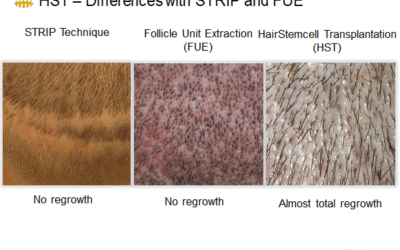

Today, patients suffering from alopecia often have two surgical options: either FUT, also called strip, or FUE. The first involves the removal, which can be quite painful especially in the post-operative phase, of a strip of scalp from the occipital donor area.
This strip is carefully dissected, and each obtained follicular unit is separately transplanted into the recipient area. Suturing the two edges of the wound created by the strip removal creates a long, truly unaesthetic scar. With the second technique, FUE, the surgeon extracts each follicular unit separately and completely, then transplants it into the recipient area. A hole forms in place of the extracted unit, which will heal through potential hardening of the donor area.
 |
 |
 |
 |
Description of the patented hair multiplication by transplantation
Hair is generated and grows from hair follicles present in the scalp. These hair follicles produce cells called keratinocytes. During growth toward the surface of the scalp, the cytoplasm of these cells undergoes complex transformations, forming a hard and elastic material: hair. The hair growth cycle is divided into three phases: the anagen phase (“growth phase”), the catagen phase (“transition phase”), and the telogen phase (“shedding phase”). The hair follicle remains the same throughout the cyclical phases of hair formation and growth. This follicle contains a growth nucleus that produces new hair after the previous hairs have shed.
The use of the patented HST method in baldness
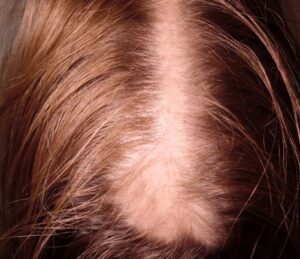
Baldness is often an undesirable phenomenon from an aesthetic point of view. However, baldness is a widespread condition affecting men as they age. Baldness also affects women and is particularly undesirable aesthetically. To counter baldness, the most used solution is hair transplantation. The FUT technique, also called strip, and the FUE technique remove entire follicular units from the donor area at the back of the head. These FUs, containing one to four hairs, are transplanted into the recipient area. The extraction comes at the expense of the donor area, which constitutes a problem. The follicular units are removed from this area to be relocated elsewhere. Where they were removed, nothing grows back. The donor area remains partially depleted. These transplantation techniques therefore offer limited possibilities for hair restoration and are constrained by the amount of hair that can be harvested from the donor area.
Hair multiplication in vitro or in vivo across the entire hair bulb
The stem cells contained in a follicular unit can be cultured once harvested via surgical extraction. It is difficult to reproduce an entire epidermis with these cells in culture, whether in vitro or in vivo. Hair stem cells harvested from mice and cultured generate hair growth when implanted. In humans, the hair reproduction method is described in European patent application 0 236 014, in which epidermal hair stem cells are removed from the patient’s scalp. The stem cells are then cultured in a pharmaceutical component containing growth factors. An incision is made in the scalp, and the stem cell portions are introduced. The disadvantage of this in vitro method is that it is invasive, and the stem cells are not implanted in a targeted manner, so many cells are needed and the likelihood of hair regeneration is lower.
The specificity of the patented Hair Stem Cell Transplantation method, or partial longitudinal transplantation
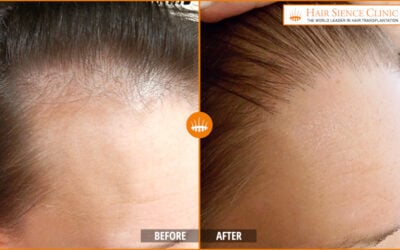
Another hair reproduction method (in vivo) is described in European patent application 0 971 679. In this case, portions of follicular units are removed from the donor area. The portion not removed regrows at the same extraction site. The extracted stem cells are immersed in a pharmaceutical component. These fertilized cells will form new hair once implanted in the recipient area. It is therefore possible to achieve hair regrowth without compromising the donor area, as is the case with other generally known transplantation techniques. The stem cells of the follicular units harvested in the anagen phase are immersed in a keratinocyte culture medium without serum.
The aim of this invention is to overcome one or more of the aforementioned problems and to provide a method for human hair reproduction in which a long culture period is not required. The extracellular matrix is produced from existing stem cells around the hair follicle. This research highlights that the extracellular matrix is essential for hair growth. In this invention, the stem cells are no longer cultured in a keratinocyte culture medium but are simply immersed for a short period in a pharmaceutical formulation of extracellular matrix. The hair is then implanted into the recipient area. With this technique, multiple hairs can grow after reconstituting a follicular unit.
The patent for the HST or PL FUT hair reproduction technique
The method is carried out according to the following steps:
- Portions of follicular units in the anagen phase are removed from the donor areas so that the stem cells responsible for hair growth remain attached to the extracted portions;
- The extracted follicular unit portions are contacted with a pharmaceutical compound containing extracellular matrix or its substitutes;
- The follicular unit portions from step b are implanted into the recipient scalp area.
Hair stem cells multiply from the same follicular unit
It is therefore not necessary to culture stem cells from a follicular unit; it is sufficient to immerse the extracted portions containing hair stem cells in the pharmaceutical formulation containing extracellular matrix components.
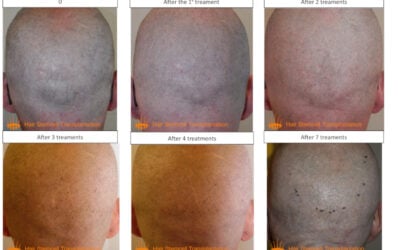
The follicular unit portions are then placed into the recipient scalp area. Consequently, from one follicular unit, others are created (in vivo clonation).
Only hairs in the growth phase (anagen) are suitable for the method described in the patent, not those in the resting phase (catagen) or the shedding/replacement phase (telogen). Anagen hairs are characterized by a distinct follicular unit shape at the lower part of the hair, which is immediately recognizable to an expert eye. Extraction of hairs in the anagen phase can be performed in various ways, provided the follicular unit remains attached to the removed hair. The difference between hairs in the different phases is clearly visible when hairs are harvested.
In step b) of the patented method, the removed hairs are contacted with a medium containing extracellular matrix components. Thus, a harvested hair can be immersed for a short period in a pharmaceutical component containing extracellular matrix. A longer contact time is not necessary. Therefore, a long culture phase (extended time in the pharmaceutical component) is not required. The term “extracellular matrix components” is known to scientists. Examples include collagen, laminin, etc., already available for cell culture. Simply dipping the portion of hair to which the stem cells are attached is sufficient for hair reproduction according to this invention. In the final step c), the hairs from step b) are implanted into the scalp.
The patented pharmaceutical component
The portion of hair to which the stem cells are attached and which has been in contact with a medium containing extracellular matrix components is thus revitalized. Consequently, implantation of the individual hair from step b) determines the growth of one or more hairs.
The pharmaceutical component preferably has a viscous consistency (for example, a hydrogel). This component contains growth factors and trace elements. Anagen hairs must be harvested from the donor area after selection.