
It is not uncommon for the dream of restoring hair lost to baldness to clash with a disappointing result that contradicts the patient’s expectations. Unfortunately, patients must first be aware of their personal situation, which we will clarify. Then, they need to know how a solution is proposed to them, which consists of a technique capable of addressing the specific case, a surgeon, and a clinic with appropriate credentials.
The Illusory Promises of a Hair Transplant
The patient should consult at least two specialists, including a trichology expert who does not perform transplants, to avoid conflicts of interest. The sensitive point is the illusory promises: when a surgeon deceives the patient to assure them. Often, the cost of surgery is emphasized, which can be a fundamental factor for the patient’s decision. The lower the cost, the more the patient is attracted to it, sidelining the crucial points regarding what can realistically be achieved as a final result.
The Patient’s Situation Before a Hair Transplant
Regarding the patient’s specific case: first, it is necessary to examine whether their hair loss is permanent or temporary. Hair may fall due to stress, medication, or other factors, making it a transient phenomenon. Alternatively, hair loss may be permanent, as in androgenetic alopecia. It should be noted that the hair follicles on the scalp are divided into two categories: those sensitive to dihydrotestosterone, which causes them to fall and are located on the top of the head, and those that are not sensitive to this hormone, remaining at the back of the head.
Is the Donor Area Sufficient for a Hair Transplant?
This last area is called the donor area. This is where follicular units are taken to be transplanted into the bald recipient area. Therefore, after verifying the stabilization and permanence of hair loss, the donor area must be assessed for both follicular unit density and surface area, particularly calculating the available follicular unit “capital.”
Choosing the Hair Transplant Technique
At this stage, once the patient’s situation is clear, we must examine the available techniques. We only consider patients who have never had a transplant before. Later, we will discuss patients who have unfortunately already undergone a transplant and why. It is important to know that publicly known techniques, even with different methods, involve taking follicular units from the donor area and moving them to the recipient area. Gradually, the number of follicular units in the donor area decreases, leaving a deficiency after harvesting.
Choosing the FUT Hair Transplant Technique
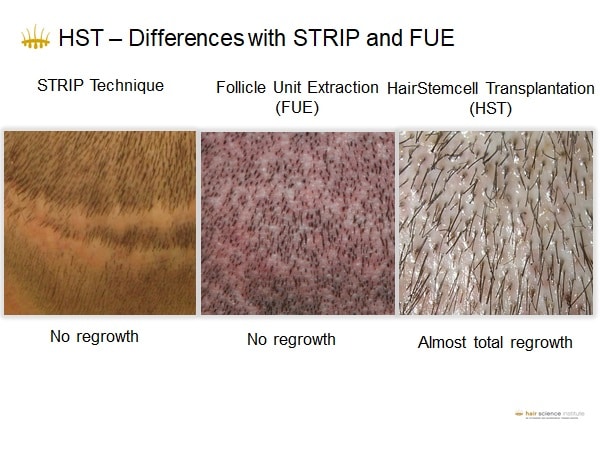
If the FUT technique is used, which involves removing an entire strip of scalp from the back of the head, it will result in a long scar that will unfortunately remain visible when wearing short hair.
Choosing the FUE Hair Transplant Technique
If instead the FUE technique is used, individual follicular units are extracted, leaving small punctures on the scalp. In both cases, the donor area becomes depleted of part of its follicular units. Naturally, if the donor area is large and dense enough, this depletion may be acceptable. However, in initially sparse areas, these removals can result in complete exhaustion of the donor area.
Limits of Donor Areas
Even a healthy donor area cannot provide a sufficient number of follicular units for significant restoration. In such cases, patients should avoid unscrupulous surgeons who might propose extremely high follicular unit harvests, sometimes up to 5,000 units. This is an aberration. Collecting that many units, especially those sensitive to dihydrotestosterone, exceeds what a donor area can provide without total devastation. The consequences of massive harvesting are: devastated donor area, potential necrosis due to trauma, and unsatisfactory results, as even 5,000 units cannot fully restore extensive baldness.
Previous Transplants with Devastated Donor Areas
The result is disappointing, and the dramatic part is that a second intervention may not be possible because no follicular units remain in the donor area. Many patients attracted by low prices trusted unrealistic promises and, if they avoided necrosis, ended up with incomplete and unsatisfactory results with no chance to remedy them.
Hair Transplant with Follicular Unit Multiplication: The HST Technique
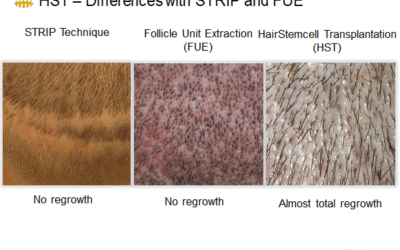
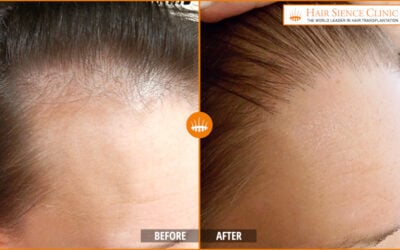
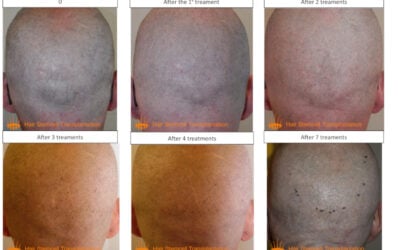
All of this occurs because the options that could give hope to patients in these conditions are often ignored. There is indeed a technique that regenerates the donor area after each intervention: HST or Hair Stem Cell Transplantation. This technique takes portions of follicular units, prompting hair stem cells to divide into two follicular units. Each part produces an exact copy of the original follicular unit. This is clearly a way to double and thus multiply follicular units, which, after nine months, are regenerated and ready for a second procedure. Recently in Italy, this technique is performed at the Hair Science Clinic in Milan and is described in detail on www.hasci-italia.it.